
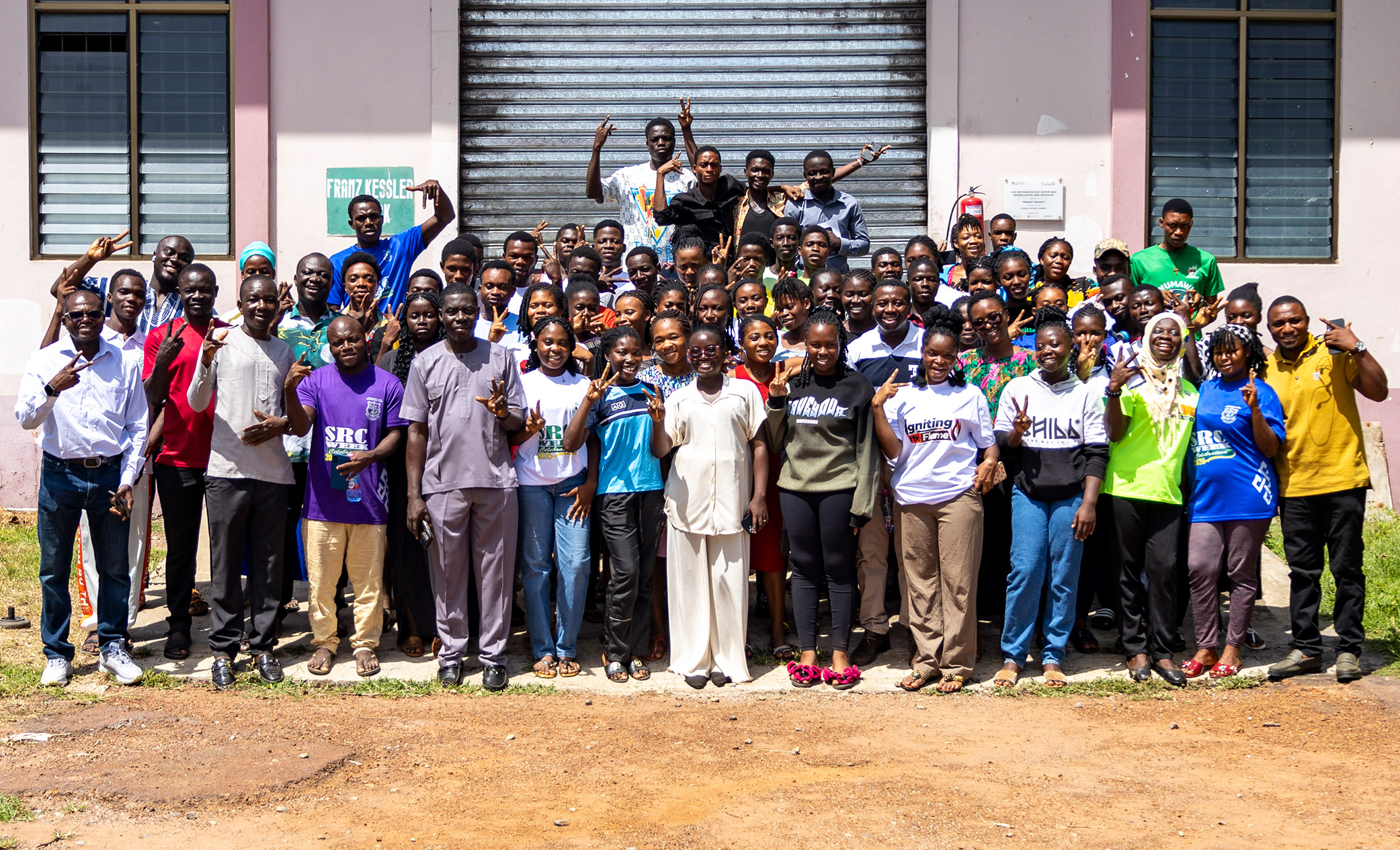
The KNUST Nutrition and Sustainable Agri-food Collaborative, in partnership with the Mastercard Foundation(Nkabom Collaborative) has expanded its transformative agribusiness training initiative to the Ejura Agricultural College and Mechanisation Centre in the Ashanti Region.
The ongoing 10-day training programme empowered 60 participants with hands-on entrepreneurial and agribusiness skills designed to drive innovation and economic sustainability within Ghana’s agricultural sector.

Addressing participants during the training session, Prof. Wilberforce Achiaw Owusu-Ansah, Entrepreneurship Pillar Lead of the Nkabom Collaborative, encouraged trainees to embrace creativity and innovation in developing agribusiness solutions.
“We need you to think innovatively and come up with business ideas that are not only good, but transformational,” he said.
He stressed the importance of value addition in agribusiness. He noted that participants must strive to develop solutions that stand out from existing market offerings.
Prof. Owusu-Ansah further assured participants that the Nkabom Collaborative would provide continuous support beyond the training period, including mentorship, business development assistance, and funding opportunities for viable agribusiness ideas.
“When you come and pitch, and we find the business worthy of support, we can give you up to a maximum of $15,000 to set up the business,” he stated.
According to him, the support package goes beyond financial assistance, as beneficiaries would also receive guidance in business registration, land acquisition processes, equipment procurement, and post-establishment mentorship.
He expressed confidence in the potential of the participants to become transformational leaders capable of driving agricultural and economic change across Ghana and Africa.
“We think that if we give you the needed push, you are the ones who are going to transform Ghana for us,” he said.

Vice Principal of Ejura Agricultural College and Mechanisation Centre, Mr. David Frimpong, commended the practical orientation of the training and its impact on students’ entrepreneurial development.
“We are excited to see how students are exploring and addressing issues surrounding society,” he noted.
He explained that the college places strong emphasis on practical agricultural training, making the collaboration with KNUST and the Mastercard Foundation particularly beneficial to students.
“I think the project is enhancing the value of the students,” he stated, adding that the partnership is helping bridge the gap between theoretical knowledge and real-world agricultural practice.
Mr. Frimpong further described the collaboration as a significant milestone for the institution, indicating that such partnerships would strengthen agricultural education and better prepare students for opportunities within the agribusiness sector.
“We are so much looking forward to it. I think this long-standing relationship is here to stay,” he remarked.
The training programme continues to expose participants to key areas including agribusiness management, value addition, entrepreneurship, innovation, and practical business development skills, all aimed at nurturing a new generation of agribusiness entrepreneurs in Ghana.


